panarama
The best burr grinder for a household that makes a pot of drip coffee every morning is the OXO Brew Conical Burr Grinder. Its hopper holds enough beans for several brews, and the start button remembers the grinding time. If you make espresso in a single-wall basket, choose the Baratza Encore ESP for its finer adjustments. For pour-over with a different coffee each day, pick the Fellow Ode Gen 2. For a single cup away from an outlet, the Hario Mini-Slim Plus is the one we would pack.
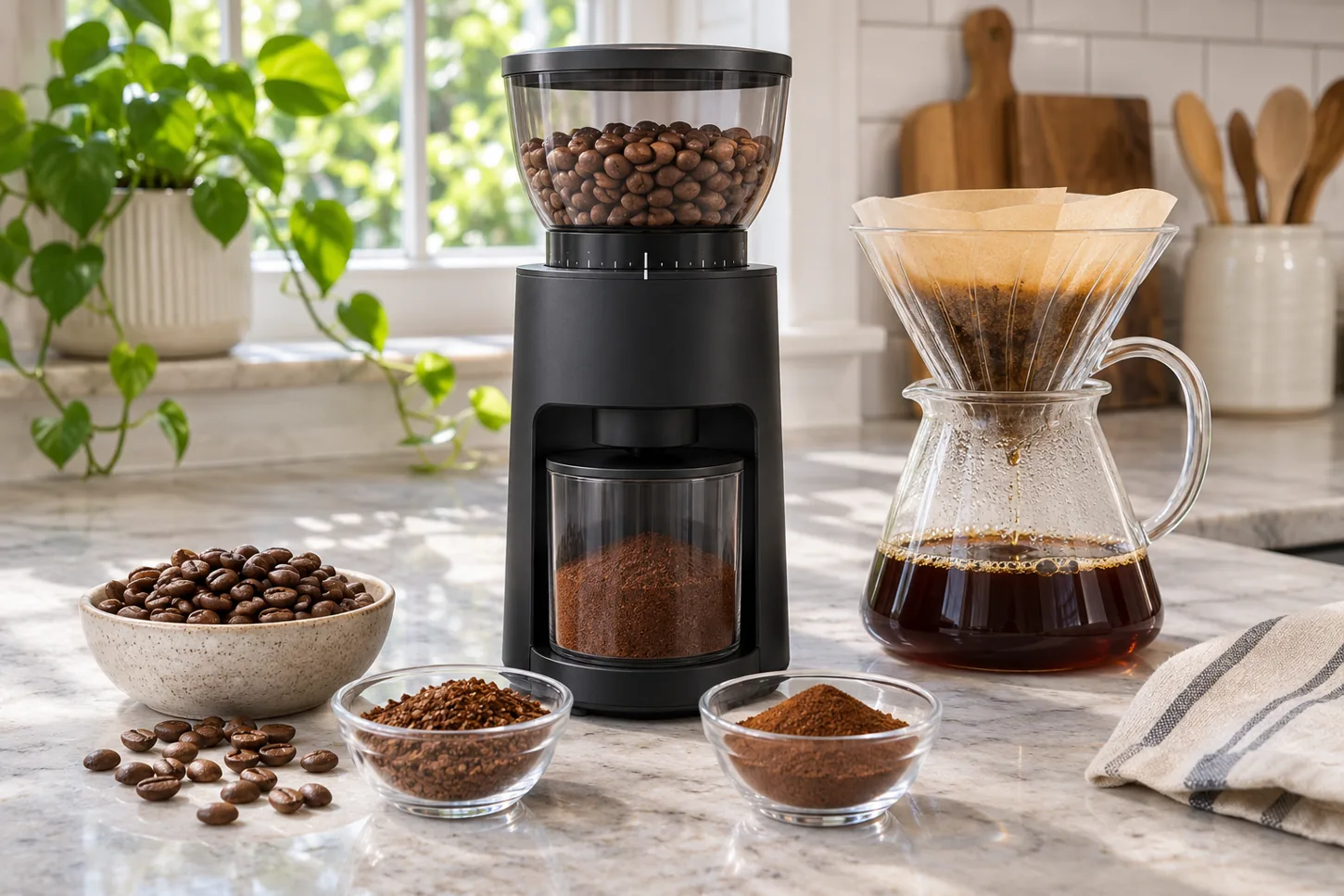
A good grinder can make the same bag of coffee beans taste more balanced and save you from discarding shots while you dial in. This guide compares four US models by brew method, grind range, dosing and cleanup. Start with the brewer you use most. A grinder can produce excellent grounds for a paper filter and still have the wrong adjustment range for an espresso machine. The capacity on the box can be misleading, too. Check what each capacity measures: whole beans in the hopper, ground coffee in the bin or the amount allowed per grind cycle.
As an Amazon Associate I earn from qualifying purchases.
Four burr coffee grinders compared by brew method
| Grinder | Choose it for | How you dose | Trade-off |
|---|---|---|---|
| OXO Brew Conical Burr | Drip coffee for a household | Fill the hopper and use a timer | Run time measures seconds, not grams |
| Baratza Encore ESP | Espresso and filter from one grinder | Switch on or pulse into a bin or dosing cup | You stop the motor and check the dose |
| Fellow Ode Gen 2 | Pour-over, batch brew and French press | Weigh whole beans for each brew | Designed for brewed coffee, outside the espresso range |
| Hario Mini-Slim Plus | Travel or one cup at a time | Hand-crank into a 24 g grounds container | Refill for larger brews |
OXO Brew Conical Burr Grinder for daily drip coffee
The silver 12-ounce OXO makes the most sense if you brew filter coffee with the same beans most days. Turn the hopper to choose the grind, set the time, and push the button. The machine remembers the previous timer setting. That saves a step on a rushed morning. We would still weigh the first few doses because switching to a different roast can change how much coffee comes out in the same number of seconds.
OXO Brew Conical Burr Coffee Grinder · Silver · 12 oz hopper

Watch the OXO grinder demonstration
What 15 grind settings and a one-touch timer do
OXO uses 40 mm stainless steel conical burrs. There are additional adjustment positions between the 15 markings, so you can refine a setting without guessing where you left the dial. Start around the maker’s medium range for a flat-bottom drip basket. After the first pot, move one step and taste the next brew before changing your coffee-to-water ratio.
Who needs a large bean hopper?
For a working supply, the OXO hopper takes up to 12 oz of coffee beans, enough for a whole 12 oz bag. If it will take weeks to use, load only what you expect to grind soon and seal the rest. If one person wants regular coffee and the other wants decaf, switching is more involved. Remaining beans and a little ground coffee from the previous grind can carry into the next dose. For switching every cup, we prefer the single-dose Fellow. For making the same coffee before work, the OXO’s push-button routine wins.
Baratza Encore ESP for espresso and filter coffee
Buy the black Encore ESP, model ZCG495BLK, if your espresso shot runs too fast on one setting and too slowly on the next with your current grinder. The ESP devotes positions 1–20 to small espresso adjustments and positions 21–40 to a wider range for other brew methods. This division matters more than the total number of markings. For home espresso enthusiasts, it gives a single-wall espresso basket room for small corrections while still letting you grind for a filter brewer.
Baratza Encore ESP · Black · ZCG495BLK
Baratza product specifications
Watch the Baratza grinder demonstration
How the dosing cup fits into a morning routine
Weigh your beans or weigh the output in the included dosing cup. Hold the portafilter and dosing cup together and invert them to transfer the grounds. If you use the larger grounds bin for a pot of coffee and the cup for espresso, leave room next to the grinder to store both. The on/off switch and front pulse button control the motor. Neither weighs a dose for you.
When you switch between an espresso shot and a pot
Write down your filter and espresso positions for the same beans. The two numbers give you a repeatable starting point. Treat the grind setting as one control in the brewing process. Test the first dose after a large adjustment separately, especially when moving from French press to a fine espresso setting. A little of the previous grind in the chute can change how that first shot runs. If you make only filter coffee, the benefit of the ESP’s finer-spaced settings is smaller.
Should you buy the original Encore or Encore ESP?
The original Baratza Encore offers 40 settings and is an excellent entry level burr grinder for pour-over and drip. It can also serve espresso in a pressurized basket. The Encore ESP also has 40 settings. Its first 20 offer finer adjustment, so it is the better choice for espresso lovers using an unpressurized basket. Check the letters ESP in the title and the model number before comparing prices or buying replacement parts. An original Encore, an Encore ESP, and an Encore ESP Pro are three distinct purchases. Baratza original Encore specifications.
Fellow Ode Brew Grinder Gen 2 for single-dose pour-over
The Ode Gen 2 is our pick for the person who weighs a fresh dose before each brew and likes to change coffees often. It is an incredibly capable grinder for clean pour-over coffee. Its 64 mm flat burrs and 31 grind settings are designed for brewed coffee. Fellow lists a 100 g grind capacity, which leaves room for either a small pour-over or a larger filter batch. The motor stops when the dose is finished, and the catch cup sits below the chute. Choose the ESP if an espresso machine is next on your list.
Fellow Ode Brew Grinder Gen 2 · Matte black · standard Gen 2 brew burrs
Watch the Fellow grinder demonstration
What you get from grinding one dose at a time
On Saturday you can weigh a light-roasted coffee for a pour-over, then use a different bag for a French press without emptying a full bean hopper. Single dosing is a workflow, not a promise that every fraction of a gram exits the grinder. For a dialed-in recipe, weigh the output as well as the beans you put in. Use the knocker as directed and keep the chute clean rather than compensating indefinitely with extra beans.
Why this flat burr grinder is a filter pick
Fellow specifies Gen 2 brew burrs in the standard model. Their intended range spans drip, pour-over, immersion and cold brew. A high price, a large burr diameter and the word “fine” on a dial do not establish espresso capability. Check the actual burr set when comparing listings. Fellow rates the stock Gen 2 burrs for body, sweetness and moderate flavor clarity. It describes its optional SSP burrs as a clearer, more flavor-separating alternative. Check the burr option if the photos of two machines look identical. Fellow’s burr comparison.
Hario Mini-Slim Plus, the best manual grinder here for travel
The Hario Mini-Slim Plus, model MSS-1DTB, is a manual grinder with conical ceramic burrs and a grounds capacity of 24 g. For someone weighing 15 or 18 g per cup, that is enough for a single brew. A 30 g recipe needs two passes or a different grinder. That simple calculation makes it easier to tell whether the Hario is a practical budget burr grinder for you. It has no cord to pack and no motor to speed up a busy breakfast.
Hario Mini-Slim Plus · MSS-1DTB · 24 g grounds capacity
Watch Hario’s four-grinder demonstration
How to keep a repeatable hand-grinder setting
The adjustment nut sits under the burr assembly. Follow Hario’s starting procedure, then note the number of clicks for your coffee and brewer. Use the same reference point each time without tightening the burrs against each other by force. If you carry the grinder in a bag, keep the handle where it cannot push against the shaft or scratch the transparent grounds container.
Who should choose an electric grinder instead?
Hand grinding is a manageable part of making a single cup for many people. It becomes a different task when you are making three cups back to back, using a very fine grind, or sharing equipment with someone who finds cranking uncomfortable. Manual coffee grinders have no motor noise. If you grind beans while someone sleeps, all you hear from the Hario is the handle mechanism and the coffee cracking. Compare a full morning’s work. The lightest grinder to pack can be the least convenient one to use for a table of four.
How burrs change what ends up in the cup
Burr coffee grinders versus blade grinders
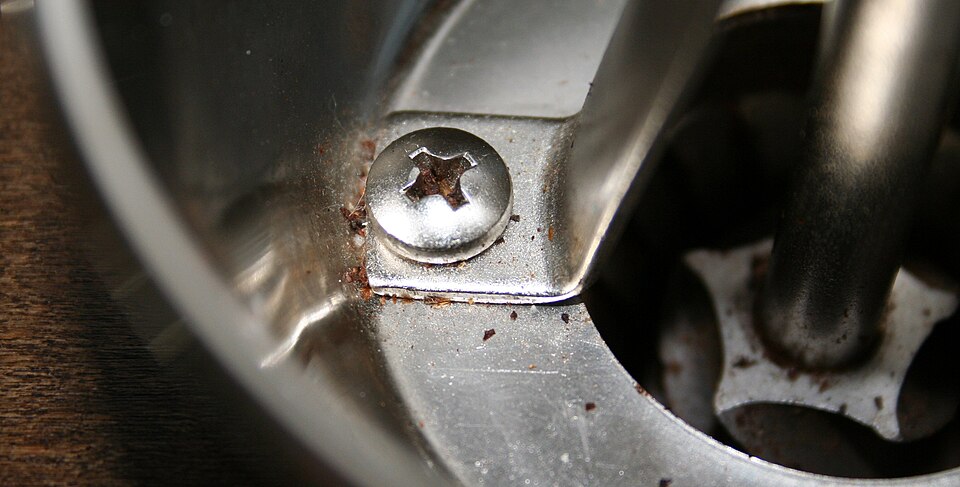
Burr grinders crush beans between two cutting surfaces separated by an adjustable gap. Blade grinders keep chopping whatever pieces pass through the spinning blade. With a blade, running the motor longer changes the mix, but some particles remain much larger than others. A quality burr grinder makes a more consistent grind size easier to repeat. A perfectly uniform particle size is unrealistic. A narrower spread makes balanced extraction easier: large fragments can contribute sourness while too many fines can make a cup taste bitter or drying. Some fines are normal even from a high quality burr grinder.
Why grind consistency matters in a paper filter
Fines can slow water through a filter bed while much larger fragments extract more slowly. If your brew tastes drying and the filter drains slowly, check both the grind and the way you poured. Heavy agitation can move fines into the paper. Hold your dose, water and pouring pattern steady, then adjust grind size. You learn more from two comparable cups than from changing your grinder, filter and water temperature together.
Flat burrs, conical burrs and burr quality
In a conical burr set, beans move through the space between an inner cone and an outer ring. Flat burrs use facing discs. Ceramic burrs appear in the manual Hario, while the OXO uses stainless steel. Burr geometry and material influence flavor and durability. A well-aligned flat burr grinder can deliver a tight particle distribution that helps separate flavors in pour over coffee, or make espresso extraction more repeatable.
Stainless steel burrs are durable. Ceramic is wear-resistant but can chip on impact. In either case, a stone in a bag of beans can damage the burrs. The grinder’s alignment, burr design and usable grind settings matter. For an espresso lover, an adjustment small enough to rescue a fast shot is a concrete advantage. For a batch brewer, a reliable medium grind matters more.
In WIRED’s own particle-size test, the Ode Gen 2 clustered its grounds tightly at a medium setting, but spread them more widely at a fine setting. The Encore ESP produced especially uniform particles at fine settings. Those two results help explain why we prefer the Fellow for pour-over and the ESP for espresso.
In a separate comparison, Livingetc rated the Fellow Ode the most consistent grinder it tested and reported minimal heat. The publication called its unit an Ode without specifying the generation. WIRED’s Gen 2 particle test · Livingetc’s Ode comparison.
Choosing a grind size for different brew methods
Setting numbers are local to each machine. A 12 on one grinder tells you little about a 12 on another. Use the maker’s brewing chart as a starting point, weigh the dose, and decide how the water and coffee behave in your own brewer.
| Brew method | Starting texture | What to watch |
|---|---|---|
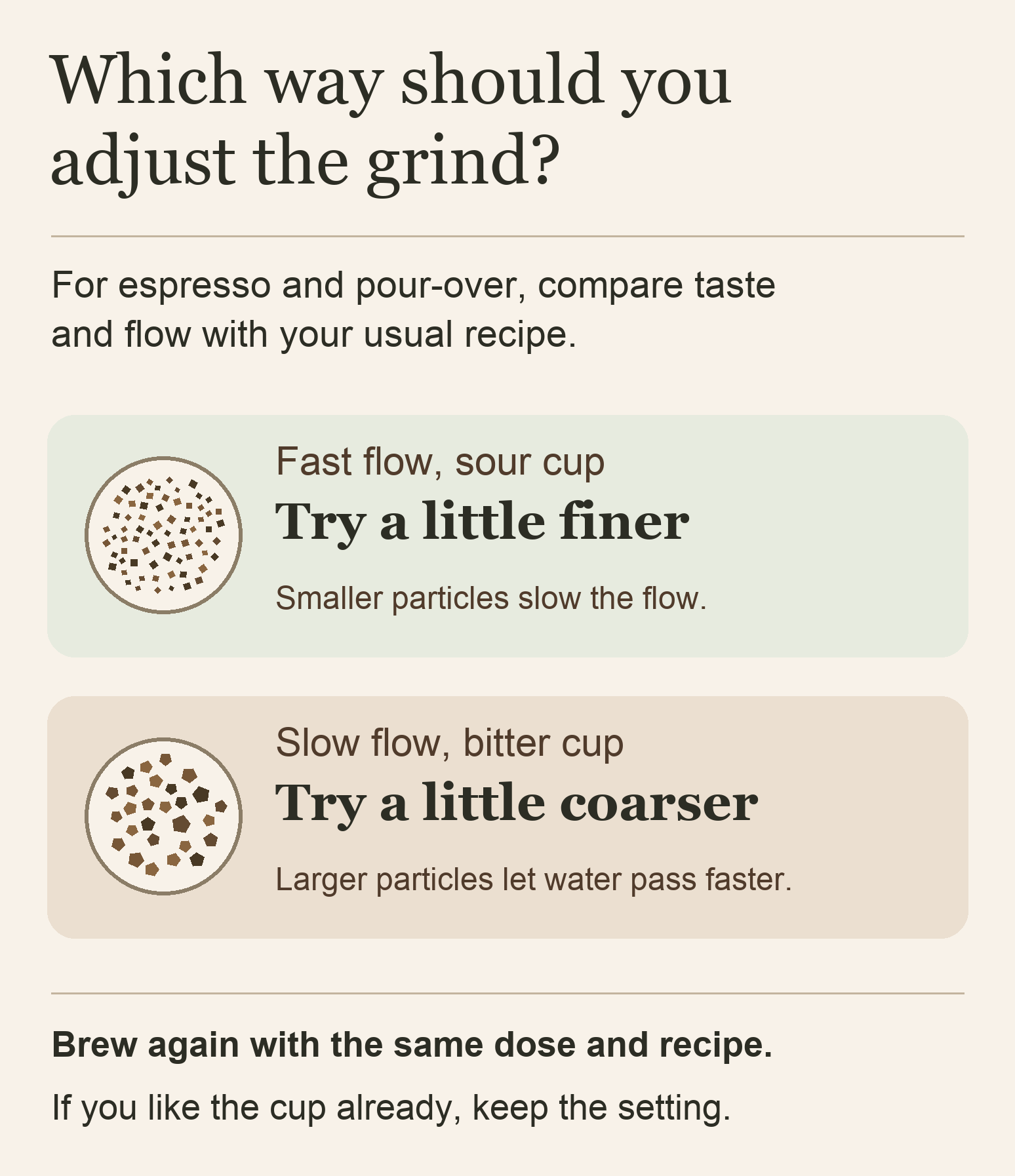
| Drip and pour-over coffee | Medium, varied by basket and dose | If the bed drains very slowly and the cup tastes harsh, try one step coarser using the same pour. |
| French press | Start medium-coarse to coarse | Adjust by taste and sediment. A longer steep can change the result without moving the dial. |
| Cold brew | Coarse grounds as a starting point | Keep steep time fixed while testing grind size. Check how easily the filter drains. |
| Moka pot | Finer than drip, coarser than espresso | Keep the basket loose and follow the pot maker’s directions. Avoid tamping the grounds. |
| Single-wall espresso | Fine with small adjustments | Keep dose and target yield fixed. If the shot runs fast and tastes thin, try a slightly finer setting. |
How to choose the best burr coffee grinder for your kitchen
How much coffee do you actually grind?
Home coffee makers and commercial grinders are often rated for different jobs. Work backward from the volume of water you typically brew. At an example ratio of 1 g of coffee to 16 g of water, a 320 g pour-over uses 20 g of coffee. A 960 g pot uses 60 g. The first dose fits the Hario’s 24 g grounds capacity. The second is three loads. The same 60 g fits within the Ode’s stated 100 g capacity. If your coffee maker labels servings as “cups,” measure the actual water used once before choosing a grinder around that label.
Time, weight or a cup selector?
A timer repeats a run time. A cup selector estimates a quantity. A scale measures mass. With the OXO, place its empty grounds bin on a kitchen scale, tare it, grind with your usual timer setting, and weigh it again. If the weight fits your everyday brew recipe, note the setting. Repeat once you change beans. With a manual grinder or a single-dose grinder you can weigh whole beans before you start, then check for grounds left behind.
Counter clearance and access
Measure from the countertop to the underside of your lowest cabinet. Allow room to lift the hopper lid, pour in beans and remove the hopper for cleaning. A grinder can fit in a photograph of a kitchen and still need to be moved every time the lid opens. Consider the route to the brewer, too. A dosing cup has little value if the only place to invert it over a portafilter is across the room.
When to spend on an espresso grinder
If you use a pressurized basket, its design supplies some of the resistance and can be more forgiving of grind variation. A single-wall basket relies much more on the ground coffee to control flow. For that setup, the Encore ESP is the strongest fit here. If your machine already has a capable built-in grinder, first decide what a second machine would solve. It might earn its counter space by handling decaf or filter brewing, even if your espresso routine stays the same.
Where a budget burr grinder makes sense
For one cup of freshly ground beans each morning, buying a motor you barely use may accomplish less than upgrading your kettle or replacing a troublesome filter. For several filter coffee drinkers on different schedules, the convenience of a motor and timer may matter every day. If an entry level grinder gives your current coffee setup the range it needs, faster commercial grinders can add cost without improving your breakfast. Compare the cost with the routine you repeat most often. A more expensive flat burr grinder that cannot serve your espresso setup is still the wrong purchase.
Cleaning, retention and troubleshooting
Why did the dose change after opening a new bag?
Different beans can travel through an electric grinder at different rates. With timed grinding, measure the output again. If it drifts even with the same beans, unplug the grinder and inspect the accessible grind chamber or chute as the manual permits. Coffee oils and fine particles build up with use. A soft brush reaches many dry surfaces. Follow the maker’s directions on any part you want to rinse, and keep water away from the motor and steel burrs unless the manufacturer explicitly permits washing.
Why are there grounds on the counter?
Anti-static technology on the Ode Gen 2 helps reduce grounds sticking to the outlet. Other grinders use a metal or glass container. Not all grinders perform equally with dry beans, and humidity also changes how much clings to a bin. Check that the bin sits fully underneath the chute, give the last particles a moment to drop, then remove it gently. If you see a large difference between bean weight and output for several doses in a row, first check the scale and the space around the outlet. An anti-static design can reduce mess, but even low retention grinders need cleaning.
How do you improve a cup without wasting expensive beans?
Use a small, repeatable recipe, write down the current grind setting and change just one thing. With filter coffee, compare drawdown and flavor. With espresso, record dose, beverage weight and shot time. If you like the change, repeat the next cup on the same setting before moving the dial again. That pause helps distinguish a genuine improvement from a difference in how you filled the basket.
Other grinders worth comparing in specific cases
Breville Smart Grinder Pro for programmable dosing
The Breville Smart Grinder Pro offers 60 grind settings across espresso and filter, with pre-programmed dosing and 0.2-second timer adjustments. It is an alternative for someone who wants a programmed espresso dose and also brews filter coffee. The Encore ESP is simpler if you already weigh each dose. A digital display helps you repeat a setting. It cannot tell whether a change in beans has made the programmed dose heavier or lighter. Breville’s US specifications
A dedicated espresso station with stepless adjustment
If the space beside your espresso machine is reserved for one blend, the Eureka Mignon Specialità is another design to consider. Its 55 mm flat burrs and stepless adjustment allow very small changes when espresso dialing calls for them. It makes less sense if you want to move from espresso to a coarse grind and back several times a day. The Encore ESP’s numbered ranges make it easier to find the previous neighborhood on the dial. Eureka’s model specifications
A hand grinder with finer espresso adjustments
If you own a 1Zpresso JX-Pro, it is worth learning its adjustment system before replacing it. The maker lists 40 clicks per rotation and 12.5 microns of vertical burr movement per click. That specification describes movement of the mechanism, not the diameter of the coffee particles. The 1Zpresso JX-Pro travel grinder is cordless and holds about 30–35 g. Livingetc reports over 200 settings. Livingetc’s reviewer also found the JX-Pro quieter than the electric grinders tested. This cordless manual grinder can suit traveling coffee enthusiasts who want fine control without the sound of a motor in a shared room. JX-Pro manual. The Hario is a different proposition for a straightforward travel pour-over. 1Zpresso’s J-series guide
A glass catch bin on a budget model
The electric Bodum Bistro is a budget option worth comparing if you want a glass catcher. The Bodum Bistro holds 220 g of beans, about 7.75 ounces. Its borosilicate glass catcher helps reduce static cling on the coffee grounds. If you dislike handling a plastic bin, it is worth comparing with the stainless steel container on the silver OXO. Check which Bistro version you are looking at. Bodum also sells blade grinders under the Bistro name. Compare the burr model and the replacement-bin availability before choosing on price. Bodum Bistro 10903 user manual
Noise, heat and the cost of replacement parts
Conical burr grinders are often quieter and more affordable than flat burr grinders, a pattern Perfect Daily Grind found when interviewing two grinder-industry specialists. The motor and sound insulation can reverse that pattern on a specific machine. Interviews on burr design and noise. Many conical home grinders run at relatively low speed. The slower grinding process can reduce heat, noise and static, helping protect the volatile aromatics in coffee oils. Baratza documented those design goals on its Encore. Bean feed, the motor, and how the burr carrier is mounted also affect the result. A quiet conical grinder can retain very little ground coffee, but shape alone gives no guarantee. Baratza’s Encore specification sheet.
Low retention grinders leave less stale coffee to mix into the next fresh dose. Single dosing keeps unused beans in a sealed bag and minimizes waste. For long-term value, look at the price, the US warranty, replacement burr availability and how easily the upper burr comes out for cleaning. A serviceable grinder can outlast a more expensive machine with a sealed grind chamber. The ESP has a quick-release burr with cleaning and repair instructions from Baratza.
If straightforward controls are your priority, KitchenAid’s burr grinder is another reference point: choose a grind and a cup or shot count, and its smart dosing system adjusts the time. The right features for your morning can offer more value than a pricier motor. KitchenAid’s controls and dosing system.
How we chose the best coffee grinders for each routine
For our best coffee grinder picks, we compared US model listings, manufacturer specifications, manuals and independent testing where available. We prioritized grind adjustment, dose control, capacity and whether the manufacturer’s intended brewing range covers the job. We verified the four specific Amazon listings for New York delivery. Prices and availability can change. Our recommendations reflect those documented differences. We did not conduct a blind taste panel or take noise, speed or grind-distribution measurements.
Questions before buying
Can one grinder handle both espresso and French press?
Yes. Of these four, buy the Baratza Encore ESP for this combination. Its first 20 positions give espresso finer steps and its second range covers filter and coarser grinding. Note your two settings and check the first dose after switching. If most of your coffee comes from a French press, the less involved OXO workflow may suit you better.
Is a hand grinder practical for two people?
It depends on the dose. Two small 12 g servings fit into one 24 g Hario batch. Two 18 g servings require a second load. If you enjoy the manual routine and travel often, that can be a fair trade. If you grind before each workday and both people want coffee at once, an electric burr grinder saves repeated setup.
Which grinder should you choose if you already have a scale?
For filter brewing with frequent bean changes, the scale makes a single-dose Ode easy to use as intended. For drip coffee with the same bag every morning, a scale is just as useful for calibrating the cheaper OXO’s timer. Choose Fellow for the single-dose filter workflow. Choose OXO if the timer and storage hopper are what you will use.
Building an espresso setup around a separate grinder? See our guide to espresso machines under $1,000 for the differences between machines with integrated grinders and those that leave the grinder choice to you.