
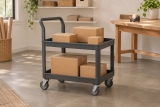
 panarama
Take a carton and a tape measure to your cart shortlist
The dimension that rules out a cart may be the space between two shelves or the distance from the door to a counter. Make a short route card before shopping. For every candidate, record what has to fit on the cart, what the cart has to pass through and where it will park. You can compare options even when sellers use different names for the same design.
Measure the surface your carton will actually sit on
Use the box you move most often. Write down its outside length and width, including a projecting lid or handhold. Compare those numbers with the usable shelf or platform dimensions. On a tray cart, raised lips and corner posts can take up space inside the advertised overall width. If the manufacturer lists only the outside dimensions, ask for the distance between the lips before ordering.
For a lower shelf, measure the height of the box with its lid closed. Think about the angle at which you would lift it out. A carton that just clears the upper shelf can still be awkward to remove if it has to pass a handle or slide past a post. Deep shelves make more sense for loose supplies that would spill from an open deck.
Test a turn as well as a doorway
Lay out the cart’s outer footprint in cardboard, including the handle. Carry it along the usual route with the shop in its normal arrangement. Pause at the tight turn near the till, the stockroom door and the spot where customers wait. Allow space for the person guiding the handle. Record the narrowest point and note whether a door closes behind you or needs another person to hold it.
Read ratings on the same basis
Keep the published total load and the per-shelf rating in separate columns. Record any condition attached to them, such as an evenly distributed load. Two trays do not necessarily divide the overall rating equally. Compare those figures with your own load, including containers and tools. If your heaviest item occupies a single shelf, that shelf’s limit matters even when the total looks generous.
Look at the wheel where it meets the floor
Photograph thresholds and floor seams along the route. Check the wheel material, diameter, swivel arrangement and whether brakes are included on the exact model. A brake listed for an optional caster set may be absent from the box. For carts that will work around displays, also look at the corner shape and where the hardware sits. Exposed hardware can reach a fixture before the deck does.
Ask for the handle height and grip width if two employees of different heights share the cart. Try those dimensions against a counter or an existing handle. Can the person see over the usual stack, and can they reach the handle when a tote extends past the edge? Record a full-load height for your route card. It can matter more on a crowded shop floor than a few extra inches of empty deck.
Compare what happens after unloading
Measure the parked footprint with the handle in the position you will actually use. For a folding model, ask whether any shelf, wheel or pin comes off before folding and where those loose pieces go. For a cart staying in service all day, find out whether a replacement wheel is sold singly or as a set. Our small-business cart comparison identifies the cart designs and model numbers you can use to verify those details against a current listing.