panarama
For a mostly open lawn with up to 1/8 acre of grass, our pick for the best robot grass mower is the Segway Navimow i105N. You can map the lawn without burying a perimeter wire and adjust the map when a flower bed grows. Before buying, walk the route from the front yard to the back. A locked gate can matter more than the mower’s advertised acreage. Below, we compare four Amazon US models by lawn size, slope, setup and the edges you’ll still have to trim.
As an Amazon Associate I earn from qualifying purchases.
If you have closer to half an acre of turf and an open spot for a reference station, start with the Husqvarna Automower 410 iQ. A property with dense tree cover calls for a closer look at the Dreame A3 AWD Pro 3500, which uses LiDAR and cameras. The much larger Yarbo Lawn Mower Pro earns its place on this list for extensive, connected stretches of grass where its tracked chassis has room to turn.
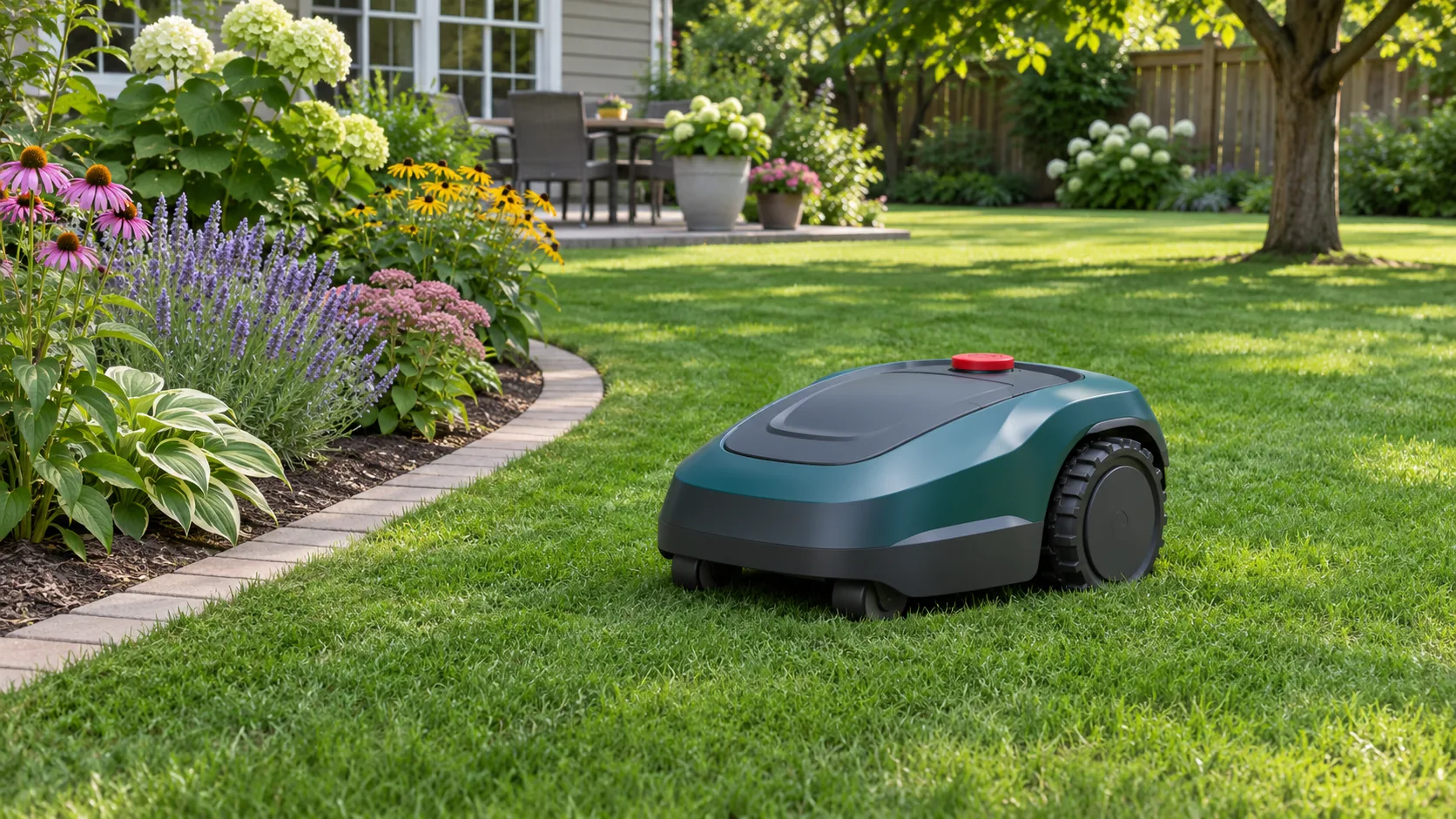
Which robot lawn mowers suit small, medium and large lawns?
| Model | Manufacturer’s lawn area rating | How it finds its way | What to check first |
|---|---|---|---|
| Segway Navimow i105N | 1/8 acre recommended | RTK satellite positioning and a camera | Sky view at the antenna and a clear route between small lawns |
| Husqvarna Automower 410 iQ | 1/2 acre in systematic patterns or 1/4 acre in irregular patterns | EPOS satellite positioning and an included reference station | The grade where the mower must turn at the boundary |
| Dreame A3 AWD Pro 3500 | Up to 0.87 acre | 3D LiDAR and binocular vision | Usable landmarks and an unobstructed path back to the dock |
| Yarbo Y40 Core with Lawn Mower Pro | Up to 6 acres when mowed twice weekly | Satellite positioning, cameras and tracks for traction | Space at gates and turns, and time to complete the property |
These are manufacturer ratings for the specified US configurations. An acreage figure describes the lawn a machine can maintain on a schedule. One charge can cover a much smaller patch. Our four recommendations are complete mower configurations offered on Amazon US. We compared product listings, installation requirements and owner documentation. Field observations are attributed to their sources.
Is the Segway Navimow i105N enough for a small yard?
Segway Navimow i105N with GNSS antenna
For a small lawn with an open antenna site and gentle edges.
Watch Segway explain antenna placement for the Navimow i Series

Choose the i105N for up to 1/8 acre of actual grass if you can give the antenna an open view of the sky. The box includes the mower, charging dock, GNSS antenna and mounting hardware. You guide it around the lawn with the app to set the boundary. Satellite corrections and a camera then help it follow a mowing pattern. The narrow 7.1-inch cutting path suits a small lawn, and the manual dial lets you leave grass between 2 and 3.6 inches tall. Segway’s US i105 specifications
Can the Navimow cut along a sidewalk?
Look at the join between grass and pavement. Segway’s ride-on boundary works where the surfaces are level, the gap is under 1 cm and there is 20 cm of clear space beyond the line. A raised curb or garden wall calls for the standard boundary and some hand trimming. The mower is rated for a 30% slope in the working area but only 10% at the boundary. A lawn that pitches toward the curb could reach the second limit first. Navimow’s slope table and boundary guide
When is the Husqvarna Automower 410 iQ the better fit?
Husqvarna Automower 410 iQ with EPOS RS1 (970727401)
For an open lawn up to half an acre when mowing in systematic rows.
The US 410 iQ suits an open lawn where you want to schedule stripes and leave the grass as high as 4 inches. Its 9.4-inch cut is wider than the Segway’s. There is an important choice in the app. Husqvarna rates the same mower for half an acre in a systematic pattern and a quarter acre in an irregular pattern. The 45% slope rating applies inside the work area. Husqvarna gives just 15% at the boundary, where the machine has to turn. Husqvarna’s US capacity and slope table
Do you need to install the reference station?
The US kit includes the charging dock and an EPOS RS1 reference station. Check Husqvarna’s cloud-coverage map for your address before mounting it. On his brother’s half-acre property, Popular Mechanics reviewer David Dritsas reported connecting the docked 410 iQ to the cloud positioning network in under two minutes. His site had coverage. Budget time for the supplied station where the cloud service is unavailable. The three pivoting blades are replaceable, and Husqvarna lists spares and a US support page for this model. Dritsas’s June 2026 field test · 410 iQ parts and support
Does the Dreame A3 AWD Pro 3500 suit a yard with tree cover?
Dreame A3 AWD Pro 3500
For a larger yard where tree cover makes an RTK antenna impractical.
Consider the Dreame if trees or a neighboring building leave you with a poor location for a satellite antenna. This version uses 3D LiDAR and two cameras to navigate, so its kit needs neither a perimeter wire nor an RTK antenna. You get a mower, charging tower and baseplate, power supply and spare blades. The 3500 has a 7.5 Ah battery and is rated for 3,500 square meters, about 0.87 acre. Its two discs cut a 40 cm (15.7-inch) swath. Check for room to place the dock on level ground with about a meter of open space around it. Dreame’s 3500 specifications and docking guidance
What does the 80% climbing figure mean for mowing?
Dreame lists 80% as the maximum slope the four-wheel-drive robot can navigate. The US manual recommends keeping mowing areas below 36% for a better cut. It also tells you to map at least 3.9 inches back from an ordinary lawn edge that stands more than 2.2 inches above adjacent ground. Those few inches can mean a regular trim along a raised walkway. Keep the LiDAR window and docking reflectors clean if the mower starts missing its approach. Dreame’s US 3500 manual, pages 20–21
Who should consider the Yarbo Y40 Core with Lawn Mower Pro?
Yarbo Y40 Core with Lawn Mower Pro module
For an open, multi-acre property with room for a tracked 20-inch machine and a clear RTK station site.
Choose this tracked 20-inch mower for acreage where a small robot would spend too much time retracing narrow passes. Yarbo rates the Pro for up to six acres when mowing twice a week. If rapid spring growth needs three or four cuts a week, build your plan around that shorter interval. The package pairs the powered Y40 Core and battery with the Lawn Mower Pro module, charging dock, Data Center and RTK antennas. Snow-clearing and blowing attachments are separate purchases. Yarbo’s coverage assumptions and kit contents
How much setup does a large property take?
The Pro’s 70% (35°) figure describes its maximum climb. Check where each pass turns and keep banks next to water outside the work area. On Yarbo’s product page, owner Michael M. reported spending about six hours mapping his roughly six-acre property, including repeated attempts to regain GPS near trees. That is one owner’s experience, but it makes a good case for walking the tree line before siting the Data Center. The tracks also need routine cleaning and tension checks between blade changes. Yarbo’s Pro maintenance guidance and Michael M.’s owner account
How we chose the best robot lawn mowers
We started with a question a spec sheet rarely answers on its own: where would this lawn mower leave you doing the work? We checked each Amazon US listing for the powered machine and mowing deck, matched the model to its US manual, and looked for the limiting instruction in that manual. That is how a 15% boundary slope on the Husqvarna mower and a below-36% recommended mowing slope on the Dreame came to matter more than either machine’s headline climbing figure.
For smaller lawns, an easy setup can be worth more than extra cutting width. For medium-sized lawns split by a house, lawn complexity matters as much as square footage. Draw the path through the side gate and mark the tree coverage on it. On large lawns, prioritize the work the lawn mower can complete in the usable hours. A buyer with two long weekend gatherings and a weekly sprinkler schedule has a different mowing window from someone who can free up the yard every weekday morning.
Does the mower cut high enough for your grass?
Start with the cut height you normally use when your lawn looks healthy. A robot lawn mower that tops out at 3.6 inches cannot give you a 4-inch finish, even if its mapping runs perfectly. At the other end, a mower whose lowest setting is 2 inches will disappoint someone aiming for a lower cut. Compare the exact deck setting with the height recommended for your species in your region. Dense or thick grass also puts more demand on the battery when the mower cuts a lot at once. Shorten the interval between cuts before lowering the deck.
How much work will a robot lawn mower save you?
Think about your last four sessions of lawn mowing. Separate time spent walking the main lawn from time spent edging, moving toys or carrying a mower between fenced areas. A robotic lawn mower can give back much of the first part. The second part still needs a plan. If a string trimmer already handles half your yard work, a robot cannot save half a Saturday just by completing the open lawn. On a broad, level yard where pushing the mower takes most of that time, the same purchase makes a much stronger case.
Most robotic mowers cut small amounts and return the clippings. If a storm gives long grass several days to grow, your only mower may need help getting back to a maintenance cut. Keep a push mower available or include occasional catch-up mowing in your yard budget. The University of Florida also notes possible wear near a dock and uncut strips near raised edges. Walk those two areas after the first week to judge the time you are actually saving. University of Florida guide to robotic lawn mowers.
What lawn size should you use to compare robot lawn mowers?
Measure the grass inside each mowing zone. Suppose the back lawn is 80 by 60 feet and the front is 40 by 30 feet. That gives you 6,000 square feet. Subtract 600 square feet for the patio and beds, and the robot will maintain 5,400 square feet, just under 1/8 acre. In that yard the i105N would run close to its rated area. Choose more capacity if you want it parked for much of the week or if spring growth often gets ahead of you.
Sketch the route between the zones. Measure the narrowest gate opening with the gate fully open, then compare it with the model’s minimum passage width and turning space. A mower that can squeeze through physically may still lack clearance to navigate or reverse. A separate patch across steps or a closed fence needs its own plan. Multiple zones in an app do not carry a machine across a step.
Measure slopes at the lawn edge as well as in the middle
Percent grade is vertical rise divided by horizontal run, multiplied by 100. A bank that rises 4 feet over a horizontal distance of 10 feet has a 40% grade, about 22 degrees. Measure across the steepest short section where the mower must turn. Compare that number with both the working-area limit and the boundary limit in the owner’s manual. For example, the Husqvarna 410 iQ permits a grade of 45% inside its work area and 15% at the boundary. A bank that rises 18 inches over 10 horizontal feet already reaches that 15% boundary limit. Husqvarna 410 iQ operator’s manual, section 3.9.3.
Mark exposed drops, ponds, retaining walls and public roads before drawing the mowing map. Follow the manufacturer’s requirements for physical barriers and setbacks. For a steep strip of slippery grass outside those limits, exclude the strip from the map and choose a separate way to maintain it.
Perimeter wire, satellite navigation or LiDAR?
A wired robotic mower follows the signal from a perimeter wire that you install around the lawn and protected beds. Its boundary does not depend on an open view of the sky. A broken wire, a new patio or a redesigned planting bed can mean locating a fault or moving part of the loop. A wired system is worth a look if you have persistent satellite dead spots, a stable lawn outline and a suitable installation route.
With a satellite-based virtual boundary, you walk or drive the mower along the desired edge to create a map. RTK, short for real-time kinematic positioning, uses corrections to refine satellite location. Tall walls, narrow side yards and dense canopy can interrupt reception. A camera can help a compatible machine bridge a difficult stretch. Whether it can do so on your route is the deciding question. An antenna-free LiDAR mower instead uses laser measurements and recognizable surroundings. Check the model’s mapping instructions, lighting requirements and return path before placing the dock.
Will it cut right to a fence?
A wheel may travel over a flush, load-bearing paver where the manual allows boundary overlap. Beside a raised fence or wall, the housing reaches the obstruction before the cutting disc can reach the last blades of grass. Expect occasional string trimming there. Before paying for an edge-cutting feature, count how much of your actual border is flush paving and how much is wall, loose gravel or planting bed.
Where should the charging station go?
Choose a level spot within reach of an appropriate outdoor power supply. Allow the straight approach and side clearance specified for the exact dock. Try the front-to-back route, return trip and tightest turn while the temporary setup is easy to move. Position cables as directed so neither the mower nor a trimmer can reach them.

Husqvarna’s EPOS guidance calls for a clear sky view at the docking point. On compatible installations, a support wire can help in parts of the lawn that lose satellite coverage, but it cannot fix poor reception at that docking point. A convenient outlet under the deck may therefore be a poor home for the charger. Husqvarna’s EPOS installation guidance.
What does the first week of mowing look like?
Bring overgrown grass to a suitable starting height according to the mower manual. Start with a higher cut and observe a full route, including the return to the charger. Check the grass after a few passes. Is the mower missing a strip along the shed, spinning its wheels at a turn or leaving heavy clumps? Adjust one setting or boundary at a time so you can see which change helped.
Frequent light mowing leaves small clippings on the lawn. University of Georgia Extension advises mowing dry grass, choosing a height suited to the grass species and taking off no more than one-third of the blade at a time. If heavy clumps sit on the surface, spread or remove them. A robot that maintains a lawn frequently is a poor substitute for clearing a season’s worth of tall growth and leaves. University of Georgia Extension’s grasscycling guidance.
Set a schedule that leaves the lawn free when people use it
Pick daylight mowing windows when children and pets are indoors and the grass has dried. Clear toys, hoses, branches and pet waste before the mower starts. Object detection is helpful, yet it cannot identify every small object or animal. Park the mower before play, gardening or entertaining. Stop it and follow the manufacturer’s disabling procedure before lifting it, clearing a jam or handling the blades.
Should you buy a model that uses a boundary wire?
If the lawn runs beneath mature trees and your planting beds have stayed in the same place for over a decade, consider the Husqvarna Automower 115H. Husqvarna rates this wired US model for 0.4 acre. A loop laid around the lawn defines its working area, so a weak satellite signal under the canopy has little bearing on where the mower turns. Husqvarna introduced its first robotic lawn mower, the Solar Mower, in 1995. Husqvarna 115H specifications · Husqvarna’s timeline.
Walk the proposed wire route with your garden spade in mind. A loop around a raised vegetable bed can serve for years, but widening the bed means moving that section. Keep a sketch so you can find the wire before planting or edging. Most mowers still leave some grass beside a high timber border because the blade sits inside the body. Allow room to trim that strip by hand. Husqvarna’s wired installation guide.
The Segway Navimow i105N offers an easy setup for a lawn of up to 1/8 acre with a suitable antenna location and beds you expect to change. If you already use robot vacuums, the app map and keep-out zones will feel familiar. With wire-free mowers like this one, you can redraw the virtual boundaries after adding a bed. Walk beside the mower on its next pass to check the new edge. Segway’s i105N setup and mapping features.
How do cutting width and battery life affect coverage on big lawns?
A wide cutting deck can finish an open rectangle in fewer passes. Short runs on either side of a gate have more turns per square foot. Put two machines with the same battery power on those different lawns, and the area completed before charging can differ. Many robot mowers also let you switch between mowing patterns. The 410 iQ illustrates how much that choice matters: Husqvarna’s half-acre rating is for systematic lanes, and its irregular-pattern rating is a quarter acre.
Will the Segway Navimow X390 mow 2.5 acres in a day or on a single charge?
The US X390 is sized for a 2.5-acre property. Segway’s US launch figures for the X3 series give up to about 1.25 acres in a full day and 0.3 acre per mowing session. Treat a claim of 2.5 acres per day or 2.5 acres on a single charge with care. Someone with 2.5 acres to maintain needs time for more than one trip back to the charging station. Segway’s US X390 specifications and its US coverage estimates.
Most residential robot mowers use a rechargeable lithium-ion battery and dock automatically. Check the time spent charging as well as mowing. For the Husqvarna 410 iQ, the typical figures are 84 minutes cutting and 108 minutes charging. Even a model that recharges in 30 minutes to two hours needs that time built into its schedule. For a lawn of 10,000 square feet, a useful first pass is to compare machines rated for at least 12,000 square feet. That optional 20% margin leaves some flexibility for wet days, travel between zones and busy weekends. Husqvarna 410 iQ charging and run times.
What should your first robot mower cost?
Entry-level robot lawn mowers start around $600, and a large-property package can exceed $5,000. A budget of $800 to $2,500 gives buyers several residential options. Area capacity, additional sensors, deck width and all-wheel drive can all change the price. For comparison, Yarbo’s US price for the Core with its Pro module has been $5,999. Check which core, dock, antenna and mowing attachment the listing includes before comparing two prices. Mowrator’s price comparison and Yarbo’s complete Core and Pro package.
Professional installation can add hundreds of dollars. For example, Minnesota dealer Midwest Turf Tech lists $500 for mower setup and boundary programming. Ask whether the quote covers all lawn zones and return visits if a mapped passage fails. For an ownership budget, add replacement blades, electricity, the eventual replacement battery and any cellular subscription you plan to use. Check whether GPS tracking for theft recovery needs a data plan separate from mowing. Midwest Turf Tech’s installation service.
Are robotic mowers quiet enough to run near a patio?
The 55 to 65 dB range often cited for robot mowers is a rough comparison. Husqvarna’s manual reports a measured sound power level of 58 dB(A) for the 410 iQ, and Segway lists 58 dB(A) for its i Series. Look for the same measurement convention when comparing models. Sound power describes the machine. The level you hear at a patio also depends on distance, hard walls and background noise. Husqvarna sound data and Segway i Series specifications.
Which smart features help on a difficult lawn?
On complex lawns, the best robot lawn mowers have navigation suited to the particular obstacle. Trees can block GPS signals on the narrow route to the front yard. A camera system can recognize parts of the lawn that look different from the path, while LiDAR can use the shape of the surroundings. Hybrid vision systems give the mower another source of information. Under heavy tree cover, try mapping that difficult side yard before investing time in the easy part.
Use the app to create stay-out zones around garden beds and exposed tree roots. Before each run, pick up the garden hose, tennis ball and small toys. Obstacle avoidance may steer around lawn decorations or a moving pet, but the lawn should be clear of people and animals during operation. A rain sensor or forecast-based rain delay can send some new robot mowers home when the weather turns. Check whether your exact mower senses wet conditions or follows an online forecast. After a storm, check the soil and pause the schedule if wheels would rut it.
All-wheel drive for steep slopes and uneven terrain
Four driven wheels can improve traction on uneven ground. Tracks, sometimes called tank treads, spread the load across more of the turf. If the ground slopes toward a pond, traction alone cannot make the turn safe. On paper, 20 degrees is about a 36% grade and 30 degrees is about a 58% grade. The i105N’s 30% interior rating is roughly 17 degrees. Other mowers advertise the ability to travel on slopes over 30 degrees, yet their preferred cutting slope can be substantially lower. The Dreame is a good example of that difference.
When is a traditional mower the better buy?
A traditional mower makes sense if you cut a remote patch only occasionally or routinely let tall grass grow into a meadow. If a regular mower is already available, keep it for the first cut after a long absence. For people who want short grass through frequent maintenance cuts, a compact robot is often a better fit than a large deck. Factor in the minutes you will still spend on raised flower beds with a string trimmer. Where garden access is narrow, the mower that finishes the job is the one that can reach every patch and get home.
Do you need a remote control lawn mower?
Choose a remote control lawn mower if you want to decide where the blade goes on every pass while standing on firm ground. The Mowrator S1 4WD uses a handheld controller. Its straight-line and turn buttons help you steer a row, but you still operate the mower throughout the job. That suits a lawn where you regularly move furniture, want to bag clippings or prefer to tackle one bank yourself. Allow time in your week to do the mowing. How Mowrator’s controls and collection modes work
Remote control means something different on a scheduled mower. With the Navimow i105N, for example, you can guide the mower from your phone to teach it the perimeter. Afterward it follows its own routes and returns to charge. If your goal is to come home to a lawn that has already been cut, look for scheduling, automatic docking and reliable travel between zones. A joystick alone tells you little about those features. Navimow’s mapping and scheduling guide
How do the best robotic lawn mowers handle rough terrain?
Walk the hardest pass before comparing machines. A shaded hill can create two separate problems. The wheels need grip where the mower turns, and its navigation system needs a reliable position under the canopy. Dreame’s A3 AWD Pro uses four powered wheels and local LiDAR and cameras. Mud on the wheels or dirt on the sensors can still interrupt its trip back to the dock. Dreame’s drive system and docking troubleshooting
For a supervised cut, the standard-tire Mowrator S1 4WD has a 21-inch deck and a manufacturer-rated maximum grade of 75% (37°). Its 56 V battery comes in 12 Ah and 18 Ah versions. Thick grass, hills and blade choice affect runtime. Inspect overgrown turf for stones, wire and holes before the first pass. Woody stems call for equipment rated for brush. Even a mower with obstacle detection can miss something hidden beneath the grass. Mowrator’s standard-tire S1 4WD · Mowrator’s battery and sensor guidance
How do the ECOVACS GOAT, TerraMow and MOVA alternatives compare?
ECOVACS GOAT A3000 LiDAR or A3000 LiDAR PRO?
The original ECOVACS GOAT A3000 LiDAR is worth comparing if your mowing window is short. In its own testing, ECOVACS reported up to 5,382 square feet in two hours, including recharge time. Use that figure to estimate how many sessions your lawn needs, then allow extra time for obstacles and turns. The A3000 LiDAR PRO adds a built-in edge trimmer for homeowners who spend Saturday tidying borders. ECOVACS announced its US PRO series at $1,999 to $2,499 MSRP. On November 24, 2026, its US store showed the A3000 PRO alone at $1,799. ECOVACS lab measurements · ECOVACS launch pricing · A3000 PRO specifications.
TerraMow V1000 or MOVA LiDAX Ultra 2000?
On a lawn of up to 0.3 acre, the TerraMow V1000 uses three cameras to map the grass. You can skip the perimeter wire and RTK antenna, and start mapping from the app. Check the first map wherever lawn and driveway meet. TerraMow showed a $1,399 regular price and a $934 promotional price on its November 2026 US sale page. TerraMow V1000 specifications · TerraMow’s US offer.
For up to half an acre, MOVA lists a 7.9-inch cutting width on the US LiDAX Ultra 2000. Use that width to picture how many passes it takes to cross a broad lawn. For a narrow side gate, check the width of the entire mower and its required clearance. MOVA’s US LiDAX Ultra 2000 specifications.
How do the Lymow One Plus and Mammotion LUBA compare on rough lawns?
The Lymow One Plus pairs tracks with two rigid rotary blades across a 16-inch cutting width. In an overgrown garden, CNET’s Adam Doud reported cutting weeds over four feet tall, with stems about three-quarters of an inch thick. That result came from one garden. Lymow specifies a finished cutting height of 1.2 to 4 inches. If you have a large lawn to maintain, check the charger in the box. Lymow rates the 5-amp package for up to 1.1 acres per day and the 10-amp package for up to 1.73 acres per day, including time to recharge. Doud’s field test and Lymow’s configurations and cutting specifications.
On a sloped lawn with patchy satellite reception, check the generation of the Mammotion LUBA you’re considering. The original LUBA mini AWD 800 and 1500 use RTK satellite positioning and cameras. The LUBA mini 2 AWD 1500 and the larger LUBA 3 AWD 1500 use LiDAR and cameras. Moving up to the LUBA 3 AWD 3000 or 5000 adds network RTK alongside those sensors. The two larger models are rated for lawns of 0.75 and 1.25 acres, respectively. Use those figures to compare property size, then check how much mowing fits into your daylight schedule. Mammotion’s LUBA generation comparison and LUBA 3 AWD model specifications.
What will you still need to do after installation?
Two lawns behind a closed gate
Picture a fenced front yard and a back lawn separated by a side passage. With the gate open, the robot may be able to follow a mapped route between them. With it closed, the robot cannot return from the second lawn to its charger. Check the manual for secondary-area operation and the weight you would have to lift. A 20-inch tracked machine and a small robotic lawn mower create very different jobs for the person at the gate.
Try the route in both directions before buying a permanent mounting bracket for the antenna. Check for a low gate latch, a downspout or exposed tree roots on the return turn. On a shared driveway, agree where the mower can travel with everyone who parks there. A parked car can block the only route home even when both lawns remain within the rated mowing area.
Cleaning, blades and winter storage
After the first few sessions, look at a handful of freshly cut grass tips. If the ends start to look shredded, stop the lawn mower, disable it according to its manual and check the blades for wear. A mower that runs several times each week can need blade attention before its owner expects it. Buy the replacement blades and fasteners specified for that cutting disc. A conventional lawn mower blade, a pivoting razor-style blade and a rigid blade from a different robot use different mounting systems.
Clear grass from the wheel treads and check the charging contacts as the manufacturer directs. Keep the camera or LiDAR window clean using the specified method. Grass stuck to a wheel can cost the mower grip, and dirt on a docking reflector can interrupt an otherwise reliable return. Before winter, look up the storage temperature, battery charge and dock instructions for the exact model. Put the charger hardware, spare blades and your map sketch together so the first spring lawn mowing session starts with the equipment you need. Dreame’s maintenance instructions and Husqvarna’s blade and storage guidance.
What to check before the return window closes
Use one normal week to observe three things. Does the robot finish each zone at the cutting height you want? Does it dock without your help after mowing the farthest patch? How many minutes do you still spend trimming edges or moving the machine? Record the places that cause a repeat stop. A local dealer can do more with a photo of a single failed turn than with a description of the whole yard as difficult. Those observations tell you more about value on your lawn than the number of smart features on the box.
Does a mower sold overseas have the same US support?
Check the model suffix before buying an imported mower. The US restrictions that made headlines for humanoid robots in July 2026 also affect new equipment authorizations for certain robotic lawn mowers. Approvals can cover specific platforms. For example, a September FCC notice names Husqvarna’s 305v iQ, 310v iQ, 420v iQ and 440v iQ. A similar model name on a marketplace listing cannot establish that it is the same US version. Ask the seller to confirm the model on the rating label and check which US dealer handles warranty service and replacement parts for it. FCC July notice and September conditional approvals.
Which mower would we buy?
For a small, mostly open yard, we’d buy the Navimow i105N after checking the antenna site and the narrowest passage. On half an acre with a suitable sky view, we’d choose the 410 iQ and measure the slope at each boundary turn. Under tree cover, we’d first investigate whether the Dreame can map the property and return to its dock reliably. On a multi-acre property, we’d compare the Yarbo’s daily coverage with the time the family can actually give it the lawn.
Before ordering, write down four numbers: square feet of grass, narrowest usable opening, steepest boundary grade and desired cut height. Compare those with the manual for the exact model in your cart. If one number rules out the machine, that is a better reason to change your pick than a longer features list.