panarama
For a homeowner who wants to keep a refrigerator, router and lights running through a one-day outage, our pick for the best solar generator for home backup is the BLUETTI Elite 200 V2 with two 200 W panels. It stores 2,073.6 Wh and supplies up to 2,600 W of continuous AC power. On the example household load below, a full battery covers about 30 hours before counting any solar recharge.
As an Amazon Associate I earn from qualifying purchases.
For an overnight outage and a kit you can carry between rooms, the smaller Anker SOLIX C1000 Gen 2 with a 200 W panel covers about 15 hours on the same assumptions. A home with a 240 V pump needs a different starting point. We checked the four complete solar kits below on Amazon US on November 24, 2026. Compare them by outage length, appliance voltage and the solar panels you actually receive. The runtime figures are calculations, and the product specifications come from the manufacturers.
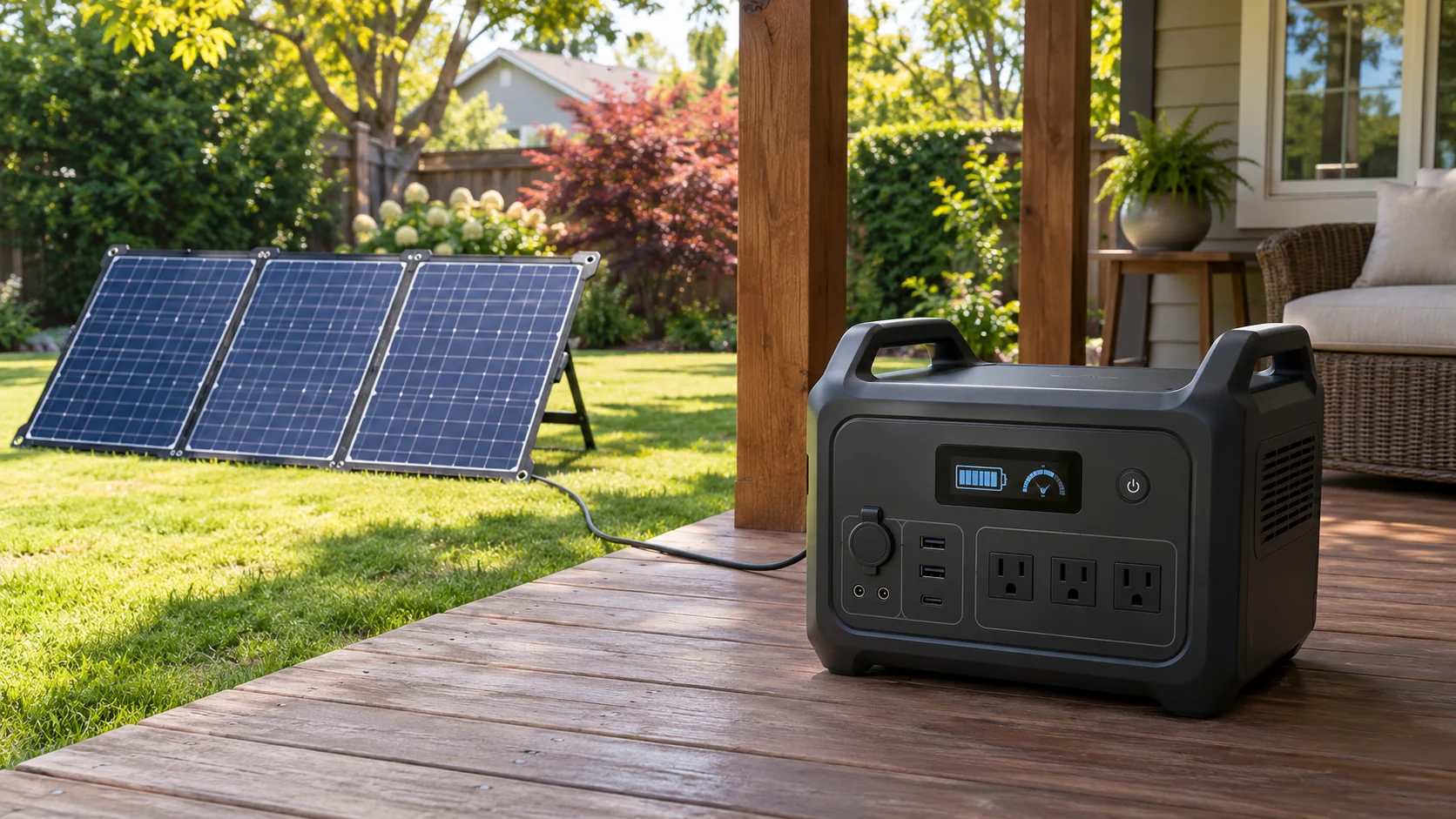
Which solar generator kit fits your home backup needs?
| Complete kit | Rated battery / continuous US AC output | Solar panels included | Estimated time on our essentials load |
|---|---|---|---|
| Anker SOLIX C1000 Gen 2 | 1,024 Wh / 2,000 W, 120 V | 1 × 200 W | About 15 hours |
| BLUETTI Elite 200 V2 | 2,073.6 Wh / 2,600 W, 120 V | 2 × 200 W | About 30 hours |
| SolarPlay Q3600 | 3,840 Wh / 3,300 W in the US specifications, 100–120 V | 2 × 400 W | About 56 hours |
| EcoFlow TITAN 5000 | 5,017.6 Wh / 7,200 W total, 120/240 V | 4 × 175 W rigid | About 72 hours |
How to read the last column. Each estimate starts at full charge, uses 80% of the rated capacity at the AC outlets and assumes the same 1,328 Wh of daily demand with no solar input. We spread that demand evenly across the day for comparison. Fridge cycling, startup demand, inverter standby consumption and the time you switch on the lights can move the result. An all-night trial with your own equipment is a better predictor.
When is the Anker SOLIX C1000 Gen 2 enough for an outage?
Anker SOLIX C1000 Gen 2 + 200 W PS200 bifacial panel
A 24.9 lb station for a refrigerator, router and lights during a short outage.

Choose the Anker when someone may need to carry the battery from a closet to the refrigerator. The station weighs 24.9 lb before you pick up the panel. Its 2,000 W of continuous 120 V output can handle short bursts of household activity, but the 1,024 Wh battery sets the limit on how long they last. A 1,500 W kettle used for four minutes consumes about 100 Wh before conversion losses, nearly a tenth of this battery. Anker’s US specifications
What can the single 200 W panel replace?
The selected kit includes one PS200 bifacial panel. Anker’s fastest solar charging figure assumes 600 W of panels. Even if the supplied panel delivered its rated 200 W continuously, replacing 1,024 Wh would take just over five hours before losses, with the appliances switched off. The Gen 2 battery has fixed capacity, so check your overnight energy use before buying it for a second fridge or freezer. Anker’s C1000 Gen 2 kit and charging specifications
Why choose the BLUETTI Elite 200 V2 for refrigerator backup?
BLUETTI Elite 200 V2 + two 200 W solar panels
Our pick for a day of refrigerator, router and light backup at the guide’s example load.
A refrigerator can cycle off for long stretches while a router draws power all night. The BLUETTI gives that pair 2,073.6 Wh of stored energy, about twice the Anker’s capacity. Its two included 200 W panels give you 400 W of rated solar input from the box. The four 120 V AC outlets share 2,600 W of continuous output. If the fridge is running when you switch on another appliance, allow headroom for its next compressor start. BLUETTI’s Elite 200 V2 kit and outlet specifications
In a discharge test, StorageReview’s Dylan Dougherty measured 1.91 kWh delivered by an Elite 200 V2 and 2.44 kWh drawn to recharge it. The reviewer received a sample and disclosed an affiliate link. This was a station test with an unspecified discharge load. It gives a useful check on usable energy, while refrigerator runtime still depends on the appliance. StorageReview’s Elite 200 V2 test.
Which setting matters when a fridge cycles off?
BLUETTI enables ECO mode by default. Its US manual directs owners to disable that mode when backing up a refrigerator or small loads that might otherwise trigger automatic shutoff. Leave Power Lifting out of your motor-start calculations, too. That feature is for purely resistive devices, and the manual gives the same 2,600 W actual output limit in that mode. BLUETTI’s US manual, sections 5.3 and 5.4
Who benefits from the SolarPlay Q3600’s two 400 W panels?
SolarPlay Q3600 + two 400 W solar panels
The largest included solar array here for several 120 V appliances and a home with outdoor panel space.
See the SolarPlay Q3600 station demonstrated by Our Black Cat Cottage
Consider the Q3600 if your home has several plug-in essentials and an unshaded place to set out two panels during a longer outage. The bundle pairs a 3,840 Wh battery with two 400 W panels. At three equivalent hours of full sun, their combined 800 W rating represents 2.4 kWh before charging losses. Compare that with your appliances’ daily consumption. The wheeled station weighs roughly 93 lb, so decide where it will sit before planning to move it between floors. SolarPlay’s two-panel kit
Why use 3,300 W for US load planning?
The kit is advertised as 3,600 W, but SolarPlay’s regional specification table assigns 3,300 W to the US version and 3,600 W to the EU version. Use the lower 3,300 W total for planning, confirm the rating on the delivered unit and observe each outlet’s limit. The US specification is 100–120 V, which rules this unit out for a 240 V well pump. SolarPlay’s region-specific specifications
When do you need the EcoFlow TITAN 5000’s 240 V output?
EcoFlow TITAN 5000 + four 175 W rigid solar panels
The split-phase option for a 240 V pump or selected household circuits with appropriate transfer equipment.
Start here if a well pump or another essential appliance needs 240 V. EcoFlow rates this TITAN 5000 for 120/240 V split-phase service, 7,200 W continuous output and 5,017.6 Wh of battery capacity. Check the appliance’s starting demand as well as its running load. Even a steady 2,500 W draw would consume the battery’s nominal energy in about two hours before losses. Decide which loads can take turns if you need power until morning. EcoFlow’s TITAN 5000 specifications and kit options
Does an oversized battery system include the integration kit for full home backup?
This bundle includes four rigid 175 W panels, for 700 W of rated solar capacity. Allow space for all four. To back up a pump on a household circuit, have a qualified electrician assess the motor, circuit and compatible transfer equipment. Even an oversized battery system may require a separate home integration kit for full home backup. EcoFlow documents its Smart Home Panel 10 for this purpose. The panel and professional installation are separate purchases. Before ordering, ask the installer to specify which circuits the finished system can support during an outage. EcoFlow’s TITAN 5000 user manual
What size solar generator will keep your refrigerator running overnight?
Find two numbers before comparing solar generators. The refrigerator’s startup demand tells you whether the inverter can start its compressor. Its energy use over a full day tells you how much battery capacity to buy. A fridge that draws 150 watts while its compressor runs may use far less energy over the day as it cycles on and off.
Start with the annual kilowatt-hours on the yellow EnergyGuide label. A refrigerator rated at 365 kWh per year averages about 1 kWh, or 1,000 Wh, per day under the label’s test assumptions. For an older refrigerator in a hot garage, use a plug-in energy meter rated for your appliance and record several normal days. A basic energy meter can help measure daily consumption even if it cannot capture a momentary startup surge. FTC guide to appliance energy labels.
Build a 24-hour energy budget in watt-hours
| Essential load | Example daily use | Energy required |
|---|---|---|
| Refrigerator | 365 kWh/year ÷ 365 days | 1,000 Wh |
| Router and modem together | 12 W for 24 hours | 288 Wh |
| LED light | 10 W for 4 hours | 40 Wh |
| Daily total | Three household essentials | 1,328 Wh |
For the examples in this guide, we budget 80% of the battery’s rated capacity for usable AC energy. That is a planning assumption for conversion losses and reserve. Actual output changes with the unit, load, temperature and time spent powering the inverter. At that allowance, the example household needs about 1,660 Wh of rated capacity to get through one day without recharging. Its needs rise to about 3,320 Wh for two sunless days. These figures start with a fully charged battery. As a second example, a 2,000 Wh unit can run a refrigerator averaging 150 W for about 11 hours: 2,000 × 0.80 ÷ 150 ≈ 10.7. That higher average draw helps explain why two households can get very different results from the same unit. A power-station manufacturer’s explanation of inverter losses.
How much power does a refrigerator need at startup?
Watts (W) describe how much power the inverter must deliver at a given moment. Battery capacity is measured in watt-hours (Wh). Multiply average watts by hours to learn how much energy a device needs. A 1,500-watt kettle used for 15 minutes consumes about 375 Wh, as much energy as a 12-watt router uses in just over 31 hours. The kettle also demands the full 1,500 W while it heats. If the refrigerator starts at the same time, even a half-full battery may trip the station’s overload protection.
Add the running watts of devices you intend to use together. A 1,000–3,000 W inverter is a starting range for essential circuits in a typical home during power outages. A router and lights alone may need much less. Larger appliances and power tools may need more power, especially when a motor starts alongside a microwave. Check the starting watts and surge duration for motors against the manufacturer’s inverter specification. Features that reduce voltage to run certain resistive loads need separate consideration. Use the continuous AC rating for ordinary comparisons, and check the per-outlet rating as well as the station’s combined limit.
How does solar charging speed affect extended outages?
Start with the energy you actually need to replace. Imagine one 200 W panel in a location with four equivalent hours of full sun. Its theoretical harvest is 800 Wh. At an illustrative 75% panel-to-battery yield, you would add about 600 Wh to storage. Apply our 80% usable-AC allowance and that recharge provides roughly 480 Wh at the outlets. The household in our table would still use 848 Wh more than the new solar energy supplied that day.

If your array delivers 500 W to the battery, replacing 1,000 Wh takes at least two hours at that rate. At 250 W it takes four hours, before any charging taper or daytime loads. A two- to four-hour solar charging claim therefore needs both a battery size and a panel configuration. Prioritize higher solar input in sunny areas when you have the panel area to use it. A second identical panel can help if the power station accepts the combined input and you have two good places to put the panels. Check the station’s solar input wattage, voltage and current limits and its approved panel configurations. A large input rating on the station describes what it can accept. The wattage and number of panels in the box determine where you start.
Will a cloudy week leave you waiting for a full charge?
A peak sun hour represents a quantity of sunlight equivalent to an hour at standard full-sun intensity. Four hours of daylight under overcast skies do not supply four peak sun hours. Shade from one fence rail, a low winter sun angle, panel temperature and the daily weather all affect energy production. Check your location and the month when outages usually happen. The national laboratory’s PVWatts tool gives seasonal context for fixed arrays. Portable panels moved around a yard will see different conditions. PVWatts assumptions and local sunlight data.
If a power outage lasts past the first day, compare the battery level at the same time on consecutive evenings. A falling reading under similar use tells you that the next night starts with less reserve. Prioritize refrigeration, lights and communications before spending that reserve on electric heat or cooking.
Can a portable solar generator power your entire home?
A portable power station can run compatible plug-in appliances directly from its outlets. A refrigerator with an accessible cord is a different job from a hardwired furnace or 240-volt well pump. Check the appliance label and the exact US model’s voltage, continuous wattage and startup rating. A larger battery extends runtime. It cannot add a voltage or output connection the inverter lacks.
To energize household circuits, have a qualified electrician evaluate the exact unit, approved transfer equipment, load list and local requirements. Never feed power into a household wall outlet. A transfer switch isolates the home from the utility, protecting workers as well as people in the house. The same planning applies to an existing rooftop system. Many grid-tied systems shut down during an outage unless they have equipment designed to operate independently. PG&E guidance on transfer switches and backfeeding · US Department of Energy on solar backup.
Which key features give essential devices reliable power during a switchover?
Emergency power supply (EPS) and UPS modes vary by model. Check the specified transfer time, supported load and bypass limits before relying on a station to keep electronics online. For medical equipment, get device-specific guidance. If someone at home uses a powered medical device, work with the device supplier and care team on an outage plan specific to that equipment. A generic watt-hour estimate is only one part of that decision. FDA power-outage planning for home medical devices.
Emergency preparedness for power outages that last several days
Give each essential device a priority. A refrigerator, a modem and two lights are a manageable starting list for emergency backup. A well pump, electric water heater and electric dryers change both your voltage and power needs. For example, sustaining a 1,000 W average load for eight hours requires 8,000 Wh at the outlets. At our 80% assumption that is 10,000 Wh of battery capacity. If the simultaneous load peaks at 7,000 W, you also need an inverter and connection rated for that load. Actual whole home backup systems can need considerably more or less depending on the house.
Multiple AC outlets let you run multiple appliances, but they share the station’s total output. Check whether a power tool or other motor will start while the refrigerator is running. For direct appliance backup, use cords rated for the load and conditions, and keep cords and connections dry. For a hardwired circuit, budget for a compatible transfer switch or home integration kit and professional installation. Even large expandable systems may sell that equipment separately. UL Solutions on portable packs and stationary storage systems.
What should you check before severe weather arrives?
Try your planned load while utility power is available. Use the display for real time monitoring of running watts after the refrigerator compressor starts. Record how much stored power the devices use in a few hours and whether the station’s low-load timer turns off an outlet your router needs. Try the physical controls with your phone disconnected from Wi-Fi. A labeled cable and a printed note about the outlet settings make emergency preparedness easier for someone else in the house.
Planning for natural disasters also means knowing the system’s limits. Check where the panels can go after wind or rain subsides and whether you have a safe route between that space and the battery. For dependable backup power through several cloudy days, a plan for another charging source or a smaller list of essential appliances can be worth more than another AC outlet. Berkeley Lab study of household solar backup during extended outages.
How does the original EcoFlow DELTA Pro compare with other expandable stations?
The original EcoFlow DELTA Pro stores 3.6 kWh, supplies 3,600 W of continuous 120 V AC power and accepts up to 1,600 W from solar panels. Its high output suits a home where several 120 V appliances need to run together. If your priority is a 240 V well pump, EcoFlow specifies two original DELTA Pro units and compatible connection hardware. Include those components when comparing costs. EcoFlow’s DELTA Pro guide.
The Jackery Solar Generator 2000 Plus is worth comparing if you already own an original Explorer 2000 Plus. One unit supports five matching expansion packs for roughly 12.3 kWh in total. Check the exact generation before buying a pack. The newer HomePower 2000 Plus v2 uses a different battery. Jackery’s compatibility guide.
The BLUETTI AC200MAX grows from 2,048 Wh to 8,192 Wh with two B300 batteries, while its solar input stays at 900 W. That buys more overnight runtime. Solar input on other large systems can range from 1,000 to 3,000 W, so expansion capacity alone tells you little about charging speed. For a larger array, BLUETTI rates its modular AC500 at up to 3,000 W of solar input with a compatible battery attached. AC200MAX specifications and AC500 specifications.
The Anker SOLIX F2000 serves both home backup and outdoor use. Its 2,048 Wh station accepts up to 1,000 W of solar input. Anker illustrates full solar input using five 200 W panels. When comparing it with a bare power station, count the panels and measure the sunny space needed to unfold them. Anker’s F2000 specifications.
When is a solar generator a better fit than a gas generator?
Portable power stations store electricity. Add compatible solar panels and you have a solar generator. The panels collect energy during the day. A charge controller manages charging, and an inverter supplies AC power to appliances from the battery. You can also charge many stations from a wall outlet before a forecast storm. That stored energy is what powers the first night, even if clouds cover the panels.
Portable solar generators produce no on-site exhaust while they power appliances, unlike gas generators, which burn fuel. Battery operation is quiet at light loads, although fans can be audible under higher loads. Put it in a dry location that meets the manufacturer’s clearance and temperature instructions, with access to the outlets you intend to use. Traditional generators that run on gasoline can keep running through several dark days if you have fuel and a safe place to operate them. The US Consumer Product Safety Commission says to keep a portable gas generator outdoors, at least 20 feet from the house, with exhaust directed away from buildings. CPSC generator safety guidance.
What are you paying for in a bigger kit?
Compare the same three things in every offer: the station’s built-in battery, its inverter and the panels in the box. A bare station can look cheaper than a solar kit with the same name. An expansion battery buys more hours after dark. Extra panels buy faster recovery on clear days, provided the station can use their output. For a purchased system to earn its space, check how far you can carry the equipment, whether rigid panels need mounting and where cables will run during rain.
Newer lithium iron phosphate (LiFePO4 or LFP) batteries often carry a cycle-life rating. Read the capacity threshold alongside the cycle number. A specification of 3,000 full cycles corresponds to roughly eight years of daily cycling. A station used only for occasional outages can age over ten years with far fewer cycles. Anker rates its C1000 Gen 2 for 4,000 cycles to at least 80% capacity. A rating to 80% means the battery can still store energy at that point, although an outage that needed the full original capacity could now require a recharge. For equipment used only a few times a year, the storage instructions, warranty period and the ease of getting a replacement panel can matter more than a difference of several hundred cycles. A long lifespan also depends on storing the battery within the manufacturer’s temperature range. Anker’s guide to battery chemistry and cycle counts.
What does a home backup solar generator cost to own?
For an initial shopping budget, compare solar generator kits in the $1,000 to $5,000 range and portable gas generators in the $500 to $1,500 range. Smaller kits can cost less, while high-output systems with extra batteries, permanent mounting or a home panel can cost much more. The Amazon links above identify the exact panel bundles. Check the delivered price, return terms and any installation quote before investing. Among the top solar generators for short outages, a smaller kit can mean less hassle if one person must move the station. Check the panel dimensions and weight alongside the price.
Sunlight has a $0 fuel cost. A battery charged from the grid still uses electricity, and a future replacement battery or inverter adds to ownership cost. For a gasoline comparison, Honda lists its EU2200i at a $1,199 MSRP, with a 0.95-gallon tank lasting up to 8.1 hours at a quarter load or 3.2 hours at rated load. Using the US Energy Information Administration’s November 23, 2026 regular gasoline average of $3.642 per gallon, 24 hours at quarter load costs about $10.25 in fuel. Twelve hours at rated output costs about $13, and 24 hours at that output about $26. A $10 to $20 daily fuel budget can fit intermittent use but changes with the load and local fuel price. Honda EU2200i specifications · EIA weekly US regular gasoline price history.
How should you budget for upkeep?
For a simple budget exercise, pencil in $0–$50 a year for routine solar-kit upkeep and $50–$100 for a portable gas unit, then replace those placeholders with local quotes. A battery station needs little routine maintenance beyond checking charge, vents, panel surfaces and cables. Engine maintenance on the Honda includes an oil change after the first month or 20 hours, then every six months or 100 hours, whichever comes first. If you service it yourself, the oil may cost much less than a shop visit. Neither allowance includes a replacement battery or major repairs. Honda EU2200i maintenance schedule.
When an installer in the renewable energy sector quotes a percentage for “energy independence,” ask which period the estimate covers. Sustainable energy solutions that look alike on an annual savings estimate may offer very different backup runtimes in December. For an outage, ask about usable watt-hours after inverter losses, winter production and how much of your load the inverter can carry at once. Those numbers put conversion efficiency and solar power in terms you can use.
Which home backup kit would we buy?
For one night of refrigerator, router and light use at the loads in our example, we’d choose the Anker C1000 Gen 2. For a full day, the BLUETTI Elite 200 V2 with two panels is our first choice. It has enough stored energy to get through that day even if the panels stay folded during a storm.
To choose the right solar generator for a longer outage, work out how many watt hours you need on the darkest day and how much solar energy you can replace on the next one. The SolarPlay kit gives a 120 V household the biggest supplied panel array in our shortlist. For a compatible 240 V load, the TITAN 5000 supplies the necessary voltage in one unit. Ask an electrician to confirm the pump’s startup demand and connection requirements before placing the order. Those checks tell you whether to spend your next dollar on battery capacity, panel area or a different inverter.